The
decorative veneers that we use at LCC are to the standard
selected by furniture makers for their finest pieces, literally
their "master pieces" - and with good reaason
Whether
from Walnut, burr oak or bird's eye maple, the natural delicacy
of colours and patterning is
brought out and enhanced by the processes
which bring the veneers from the
forest to the interior of your car. Shaped
gently to the surfaces of your interior, both curved and
flat, the natural veneers are not subjected to bleaching
or artificial colouring (unless you request it!). Neither
are they bent round a plastic substrate, glued together
at high temperatures and then painted over to achieve a
crude parody of the beauty of the living wood.
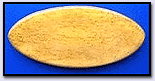
Birds Eye Maple Veneer
Our
craft apprenticeships taught us to respect that beauty,
to ensure that the veneers (obtained from well managed,
sustainable resources) retain their natural patterning and
rich colour beneath the lacquer applied as a protective
finish against the ravages of heat, light and damp. Consistency
is assured because each job we undertake is completed from
one single source of veneer - and moreover, matching sections
are selected for use on either side of the interior, thus
achieving a "mirrored" effect, normally from thr
centre line of the dashboard.
It
follows that the original source of the veneer, the burl
(which literally means "knot"), must provide the
most pleasing of natural, tightly scrolled pattern and must
above all be free of blemishes, for nothing will be disguised.
Great skill and experience are needed to select from thousands
of acres of trees those most likely to yield the best patterning
and colour. In the case of walnut, only trees that are past
their nut-producing years will be used, which means they
can be anything from 60 to 100 years old and can weigh up
to 1500 lbs. A typical price for a good burl is about £6,500
/ $10,000 - but a really exceptional one can cost up to
$50,000.
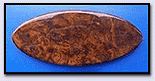
American Burr Walnut Veneer
During
the initial production processes, in factories close to
the forests, the freshly dug burls are "simmered"
in water for a week or more at different temperatures until
the most pleasing colour is obtained. Then the bark is stripped,
the wood cleaned and the entire burl fitted onto a special
lathe. We need to be certain that the separate pieces of
veneer we will ultimately use are individually flawless
and will mirror each other perfectly. The length of the
slices, where the cutting of each one begins and ends, needs
careful consideration as the huge "logs" are first
mounted on spindles and then rotated against sharp blades
on the lathe.
Once
the veneer is cut into wafer-thin slices, a mere 0.6mm thick,
it is steamed for anything between 24 hours and a week.
Gradually, almost magically, more colour starts to emerge.
At first it is a curious green, but later, as experts monitor
progress every few hours, rich, orangey browns come to predominate.
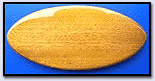
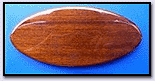
Straight Grain Sapp Walnut Veneer
Sheets
of matured veneer are set aside in batches for further scrutiny
an selection. Perhaps only one percent of total production
from a burl will be of sufficiently high quality for LCC
to use. The best veneer is found on the outside of the burl;
the deeper the slice, the plainer (and therefore less pleasing)
the patterning. At LCC we demand the biggest and the best
sheets, the cleanest and the most consistent patterns -
and we get them.
We
use other woods besides burr walnut - burr oak, for example,
or bird's eye maple (where the naturally pale and creamy
colour can be readily stained in subtle reds and greys and
blues), but burr walnut is the most frequently requested
veneer, with its great depth and variety of colours and
natural patterning. Striaght grained walnut is used for
graceful crossbanding. Boxwood is selected for contrasting
inlays.
Straight Grain Sapp Walnut Veneer
- Stained
The
reveneering or restoration of your woodwork, each section
carefully positioned for its mirrored effect with its opposite
partner, cannot be rushed. When all is perfect, we apply
the protective lacquering to your woodwork and then polish
it to a high gloss with wax-impregnated compounds applied
by a linen cloth on a buffing machine. The result is a positively
glasslike finish, through which glows the natural, carefully
nurtured beauty of fine wood.